Yeah, you read the title right:
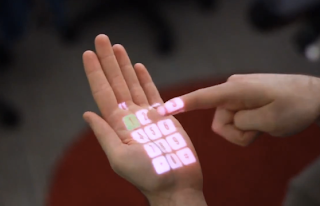
laser-projected keys. An entire keyboard on your arm, or the dial-pad on your palm -- how future tech is that, right? Though, taking into consideration that Sergey Brin and his "X Lab" team (who recently developed
automated, self-driving cars) have been on the Google Glass project, it's not too surprising that there would be some really cool innovations.
 |
| What's next? Side-mounted jetpacks? (Please?) |
According to the patent filed by Google, this new laser-project keypad "can be projected onto a surface and components of the keyboard detect finger movements and translate the movements into keystrokes on a device." Basically, the Glass is getting
reeeeal Minority Report up in here.
"A projection keyboard unit generally includes a laser to project a visible virtual keyboard onto a surface (e.g.,
a red diode laser as a light source to project a full size QWERTY layout keyboard, with a size of 295 mm x 95 mm projected at a distance of 60 mm from the projection keyboard unit), and a sensor or camera to sense finger movements. A location or detected co-ordinates of the finger can be used to determine actions or characters to be generated," continues the patent.
While it certainly sounds awesome, concerns are already being voiced. "Eh, that's still cool and everything but I've heard gripes from serious typists that a disadvantage of laser keyboards is there isn't that familiar click you get from the springs of keys in mechanical keyboards that have buttons when you are using laser or virtual ones," comments phys.org user Mycobacter.
Regardless of the kinks that may still need to be worked out (including the possibility that they may go an entirely different route in the final stages of development), this laser-keyboard has the obvious potential to really change the way we use our mobile electronics in much the same way texting on a cell phone did.
What do you think about Google Glass? Will it ever be truly feasible, and if so, will it actually be as big as many people anticipate?
The patent says that the
virtual keyboard "can be projected onto a surface and components of the
keyboard detect finger movements and translate the movements into
keystrokes on a device. A projection keyboard unit generally includes a
laser to project a visible virtual keyboard onto a surface (e.g., a red
diode laser as a light source to project a full size QWERTY layout
keyboard, with a size of 295 mm.times.95 mm projected at a distance of
60 mm from the projection keyboard unit), and a sensor or camera to
sense finger movements. A location or detected co-ordinates of the
finger can be used to determine actions or characters to be generated. "
Read more at:
http://phys.org/news/2013-01-google-glass-laser-projected-keyboard.html#jCp
The patent says that the
virtual keyboard "can be projected onto a surface and components of the
keyboard detect finger movements and translate the movements into
keystrokes on a device. A projection keyboard unit generally includes a
laser to project a visible virtual keyboard onto a surface (e.g., a red
diode laser as a light source to project a full size QWERTY layout
keyboard, with a size of 295 mm.times.95 mm projected at a distance of
60 mm from the projection keyboard unit), and a sensor or camera to
sense finger movements. A location or detected co-ordinates of the
finger can be used to determine actions or characters to be generated. "
Read more at:
http://phys.org/news/2013-01-google-glass-laser-projected-keyboard.html#jCp
The patent says that the
virtual keyboard "can be projected onto a surface and components of the
keyboard detect finger movements and translate the movements into
keystrokes on a device. A projection keyboard unit generally includes a
laser to project a visible virtual keyboard onto a surface (e.g., a red
diode laser as a light source to project a full size QWERTY layout
keyboard, with a size of 295 mm.times.95 mm projected at a distance of
60 mm from the projection keyboard unit), and a sensor or camera to
sense finger movements. A location or detected co-ordinates of the
finger can be used to determine actions or characters to be generated. "
Read more at:
http://phys.org/news/2013-01-google-glass-laser-projected-keyboard.html#jCp
The patent says that the
virtual keyboard "can be projected onto a surface and components of the
keyboard detect finger movements and translate the movements into
keystrokes on a device. A projection keyboard unit generally includes a
laser to project a visible virtual keyboard onto a surface (e.g., a red
diode laser as a light source to project a full size QWERTY layout
keyboard, with a size of 295 mm.times.95 mm projected at a distance of
60 mm from the projection keyboard unit), and a sensor or camera to
sense finger movements. A location or detected co-ordinates of the
finger can be used to determine actions or characters to be generated. "
Read more at:
http://phys.org/news/2013-01-google-glass-laser-projected-keyboard.html#jCp


